
Retrofitting Britain’s housing stock is a climate change imperative and a public health emergency. An updated INCA report sets out the scale of the challenge, and the evidence that the best way to tackle both problems is to take a fabric first approach, particularly in government mandated and funded programmes.
Making homes more energy efficient and therefore cheaper to heat is both healthier for residents and better for the environment, and will save billions of pounds that would otherwise be spent on NHS treatment, welfare payments, heating bills and lost opportunity. Pursuing carbon reduction alongside energy efficiency will tackle fuel poverty and climate change simultaneously.
The high price of electricity means that low carbon heating technologies, such as heat pumps, can be more expensive to run than a gas boiler. Simply changing the heating system will not improve the lives and health of residents if they still cannot afford to heat their home. Energy efficiency programmes must continue to prioritise fabric – and the single most impactful fabric improvement is insulation.
Government research finds that the most effective single retrofit measure for improving a building’s energy efficiency is solid wall insulation, especially when installed alongside measures like heat pumps and solar panels. When designing schemes which support retrofit, particularly for low income households, government should be considering a holistic approach which will have the widest impact and the largest payback.
Why Fabric First Is Right – Updated For 2026
First published in 2025 the comprehensive evidenced based INCA report entitled “Why Fabric First Is Right” has been updated for 2026 and includes a foreword from Colin King who explains:
Why Fabric First Still Matters
In these days of increased tensions and pressure over fuel security and rising fuel poverty, adopting a fabric first approach remains a sensible strategy for a fundamental reason: the most affordable, clean, and dependable energy is the energy you never have to use.
All other solutions—such as heat pumps, solar panels, batteries, and smart controls—perform more efficiently after the building envelope has been properly addressed, and energy demand reduced.
A fabric first strategy, which focuses on insulation, airtightness, and minimising thermal bridging, remains the most economical and future proof method to decrease energy demand, lower emissions, and enhance comfort, regardless of technological advancements.
Energy prices may vary, but insulation remains unaffected by these fluctuations.
- Reducing heat loss by 30–60% delivers predictable, locked in savings.
- Even if energy prices decrease, the benefits persist.
- If energy costs rise, you are protected.
Implementing a fabric first approach correctly provides:
- Fewer cold spots
- More stable indoor temperatures
- Reduced condensation and mould
- Quieter interiors
- Improved summer comfort (with appropriate design)
Comfort represents a quality of life improvement, not merely an energy efficiency upgrade.
Improved fabric results in:
- Smaller heat pumps
- Reduced radiator or underfloor heating requirements
- Smaller photovoltaic arrays needed to offset demand
- Reduced battery storage
- Less dependence on complicated controls
A fabric first approach aligns with building physics and reduces energy demand to a level where electrification of heat makes sense in terms of running cost and national capacity.
Colin King
Bio: Through his own consultancy CKC, Colin provides technical support to housing providers, and government on hard-to-treat (HTT) buildings, working in particular with DESNZ on the decarbonisation of social housing and MHCLG where he delivered a review of the Housing Health and Safety Rating System on housing standards in the rented sector.
A former director at BRE where he led work on retrofit energy performance and hydrothermal analysis, Colin currently sits on the Retrofit Task Force, Chairs CB401 for the BSI on new Energy Standards and BS5250 Management of Moisture in Buildings Steering Groups for Part C, F and L of the Building Regulations in England and Wales. He also acts as Expert Witness, trains Retrofit Co-Ordinators, provides technical support to warranty providers and remains active across numerous other leading technical and research groups.
Help Us Get Fabric First Back On The Agenda
With the Warm Homes Plan now published it’s abundantly clear that, whilst external wall insulation has not been completely abandoned, the main domestic retrofit focus is on heat pumps, solar PV and battery storage. But, according to the latest Government statistics, “at the end of December 2025, there were an estimated 8.5 million homes with solid walls in Great Britain (Chart 13, Table 7.6 below). Of these, it is estimated that 909,000 (11%) had solid wall insulation and 7.6 million (89%) were uninsulated”.
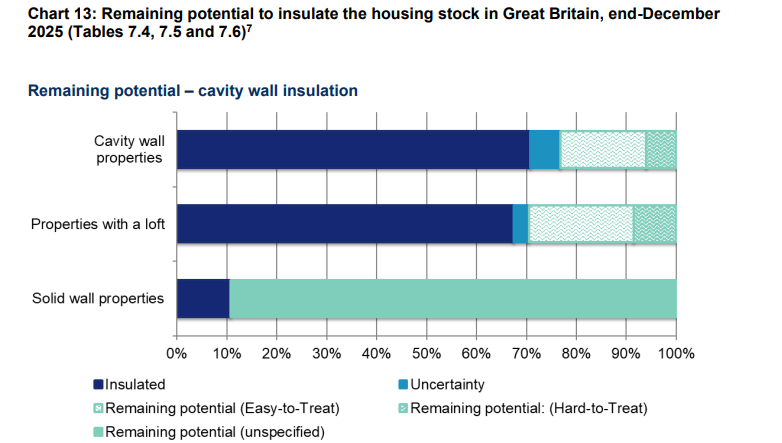
So the shocking facts are that there are still families living in around 7.6 million solid wall properties which are completely uninsulated. These are old houses, some of them of non-traditional post war construction and thermally inefficient. They leak energy and installing a heat pump, solar PV or battery storage is not going to solve the problem – it will just mean that more efficiently produced energy will be wasted!
Back in 2024 the Department for Energy Security and Net Zero published a report based on the findings of the Demonstration of Energy Efficiency Potential (DEEP) project. Commissioned by DESNZ this was one of the UK’s largest research projects into retrofitting solid walled homes and has expertise from three universities:
- Leeds Beckett University (LBU) led the project and used case study field trial investigations to measure technical performance and risks, before and after retrofitting 14 solid walled homes. LBU then compared the measured findings to the modelled predictions.
- The University of Salford replicated one of the LBU case study retrofits in the Salford Energy House to explore the issues under more controlled conditions, and to identify the impact these retrofits have on heating system efficiencies.
- Loughborough University modelled risks associated with retrofits and undertook scenario analysis to investigate situations that could not be observed in the field studies.
The findings confirm that solid wall insulation (SWI) is the most impactful single measure for older, uninsulated properties, reducing whole-house heat losses by 19% to 55%.
This report is not alone in its findings – the Committee on Fuel Poverty state the “the best path toward sustainability for low-income households has to be a fabric first – insulation, insulation, insulation – approach”. The Heat and Buildings Strategy says “improving energy efficiency by adopting a fabric-first approach is key in ensuring the transition to low-carbon is cost-effective and resilient”. Even Ofgem, in their Boiler Upgrade Scheme guidance agree that “heat pumps perform best in a well-insulated home” and “insulation measures, such as cavity wall or loft insulation” (interestingly no mention of external wall insulation!!!), “can significantly reduce heat loss and may help improve the performance of a low-carbon heating system”.
These examples are just a tiny proportion from those, like INCA, advocating a fabric first approach to retrofit. The INCA Why Fabric First Is Right report is designed to add our weight to the argument – we will be publicising and circulating widely in an effort to get fabric first recognised as the most effective retrofit methodology and back on future Government agenda.
INCA Report: Why Fabric First Is Right 2026 – Download Your Copy
The INCA Why Fabric First Is Right report is available in A4 printed format which will be distributed at all INCA events and exhibitions over the course of the year as well as an electronic PDF download which will be widely promoted and shared via our social media platforms.
We will also be posting it out to relevant Government Ministers, key civil servants and appropriate departments as well as to key figures from across the opposition parties. We will also be using it to strengthen our own message when working alongside our like thinking lobbying partners from across the wider energy efficiency industry.
If you would like any printed copies please email info@inca-ltd.org.uk and let us know how many copies you require and where to send them.
To download your PDF version simply click the image or the link below:
We would really value your support in helping us spread this message so please share our social media posts and do what you can on a regional basis (local MPs etc). We are happy to send copies for you to distribute or to email / post out on your behalf – just let us know who to and where to send.