

The Background to the need for Industry Competence
In her report, Building a Safer Future, Dame Judith Hackitt spoke of the industry’s approach to competence as being “fragmented, encompassing a range of disciplines and different competence frameworks even within one discipline and without reference to other interacting disciplines”.
The Building Safety Act 2022, together with supporting secondary legislation, has introduced a new regulatory regime, which requires the engagement of everyone working in the built environment, not just those involved in Higher-Risk Buildings (HRB). This includes new duties on individuals and organisations that commission, design, construct or refurbish buildings, to ensure they comply with Building Regulations. Duty holders, both individuals and organisations, are required to be competent to undertake their roles.
As a result there is a legal requirement to demonstrate competence, and this has been defined in the Building Safety Act 2022 and the Building Regulations etc (Amendment) (England) Regulations 2023 as:
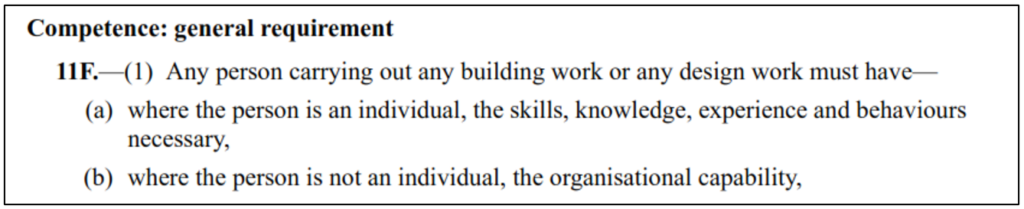
It has been confirmed that the BSR will audit the competence of those working on a higher-risk building, acting as the Building Control Body. For all other buildings, the Building Control Body will audit competence.
Industry Competence – A Who’s Who
The Industry Competence Committee (ICC) was formed under the Building Safety Act 2022 to provide strategic leadership, assistance and encouragement to facilitate the improvement of competence in the built environment industry. It answers to the Building Safety Regulator (BSR) and advises both the BSR and industry on matters of competence.
The Industry Competence Steering Group (ICSG) is a working group sitting directly below the Industry Competence Committee and has been established to help enable culture change in relation to competence across the built environment in the UK. It works through Sector Led Groups which are long term committees aimed at bringing together appropriate representatives in industry to collaborate in developing and implementing standards of competence relating to a particular sector, role, function, discipline or specialism. It does this by providing the industry access to consensus agreed competence frameworks, guidance and routes to competence. This allows individuals and organisations to demonstrate that they can safely contribute to the creation and use of buildings and constructed assets.

Each Sector Led Group is required to develop and implement a competence framework for their own industry in two phases:
Phase 1 – development of the competence framework
There are three parts to this phase:
- A Strategy – defining the scope of the competence framework and an overview of the roles covered, identifying and calling out the gaps in current competence and any identified steps required to develop and implement a fully functioning competence framework.
- The SKEB Statements – outlining the skills, knowledge, experience and behaviours (SKEB) required to obtain competence in the role(s) covered by the framework.
- A Route to Competence – showing the path (or paths) to obtaining initial competence, and then maintaining, individual competence in the occupation(s) over time.
Phase 2 – once the Strategy, SKEB Statement and Route to Competence has been created, the Sector Group moves into an implementation group for the roll out of actions identified as follows:
- An Implementation Plan – identifying what practical steps are required (as well as a timeframe) to allow the review/development of training/ assessment requirements to be implemented. It also includes what individuals in scope to the competence framework will need to do to come into compliance with its requirements.
- Implementation itself.
The Work of the External Wall Insulation (EWI) Sector Led Group
INCA are proud to have been chairing and leading on the work of the external wall insulation (EWI) Sector Led Group (10.1 – Building Envelope).
As a result of the considerable efforts of the various committees and working groups made up of a highly representative cross section of willing and supportive volunteers from across the entire external wall insulation industry along with the administrative support of the CITB, we are pleased to confirm that phase 1 is fully complete and phase 2 is at advanced stage.
The External Wall Insulation Competence Framework is now formally published and consists of:
Routes to Competence: Three key areas:
- for a new entrant
- for someone who has some skills, knowledge, experience and behaviours
- for an experienced worker.
Functional Map: A grouping of functions together to show competencies for a specific role. This will be used to form the basis of any new qualification structures in the future. It may look very similar to existing competence qualification structures as the groups of functions are likely to be the same. It is the finer detail found in the Trade Specific Competencies that will outline the next level of detail.
Core Trade Competencies: These are the common requirements for this trade more generally.
Trade Specific Competencies: These are the functions themselves, when put together with other functions they become the competence requirements for a particular role. Use the Knowledge and Skill tabs (where applicable) to reveal or conceal additional details within sections.
Experience: Requirements set out by the Sector Group. These will form part of any checks carried out to validate competence initially as well as what is required for revalidation purposes. This could be a number of CPD hours that an individual is expected
to undertake, observation of fire or safety critical installation activities on an annual basis or requirements that in the future would be required to trigger a construction scheme card.
Behaviours: Based on those found in BS8670-1:2024 the behaviours are what is expected from individuals working in this role. It is felt that most of these would be monitored by an employer on an ongoing basis, some might be added to competence
qualifications where they can be demonstrated during the time served on an apprenticeship for example.
The (EWI) External Wall Insulation Competence Framework
The development of this External Wall Insulation (EWI) Competence Framework aims to establish a structured, standardised approach for assessing and ensuring the competencies of installers working in the external wall insulation sector. The framework serves to address the growing demand for high-quality and safe installations, promoting the development of skilled professionals who meet industry standards.
The framework outlines key competencies required for the EWI installation process, including installation, health and safety, training and qualification landscape and any re-validation requirements. It is designed to guide training programs, qualifications, employers, workers, regulatory bodies across the industry. This competency model is intended to reduce risks associated with poor insulation practices, improve building performance, and ensure compliance with relevant regulations and standards.
Key components of the framework include:
- Routes to Competence: Identification of the recognised routes to achieving competence.
- Competency Levels: Clear definitions of the Skills, Knowledge, Experience & Behaviours required for each function and role of the EWI installation process.
- Technical Skills: A comprehensive understanding of materials, techniques, and equipment used in EWI systems.
- Health and Safety: Emphasis on safety standards to minimise accidents and ensure safe working environments.
- Sustainability and Efficiency: Incorporating best practices for energy efficiency, sustainability, and the long-term performance of external wall insulation systems.
The framework is intended for use by industry professionals, training providers, and regulatory bodies to create a consistent and accountable approach to competency in EWI installations. By ensuring that installers meet the framework’s requirements, the industry can improve the quality of external wall insulation projects and support regulatory compliance.
External Wall Insulation Competence Framework Development Process
The development process involved extensive consultation and collaboration through a series of working group meetings with SLG10 Installation and Maintenance (previously WG2 Installers), INCA and other federations/ associations representation, employers, manufacturers, training providers and CITB. An online survey and webinar were also available to present the Competence Framework and offer an opportunity to review, provide feedback, support and validate the framework development.
Thorough analysis of existing competencies, existing standards, training, qualifications, current working practices and known issues and challenges were carried out to help inform the framework and identify actions that need to be addressed.
The working groups were generally very well attended and were conducted in a very cooperative, open and friendly manner with all participating getting the opportunity to contribute to the discussions and development work being carried out in relation to the SKEB.
Revalidation of competence was also considered during the development stage and will be finalised during the implementation phase.
Outcomes and Findings
The following 5 significant actions were identified as required to be addressed as part of an implementation plan:
- Develop an English and Welsh apprenticeship – work at advanced stage thanks to Abi Smith and the IAA
- Find providers for the Modern Apprenticeship in Scotland – completed
- Roll out a Specialist Applied Programme (SAP) for the level 3 NVQ – advanced stage, delivery Q3 2026
- Develop short duration training courses that align to the Framework – completed and under roll-out
- Introduce Fire Safety in Buildings training as a mandatory competence requirement for installers – completed
Barriers identified to addressing the actions listed above included a substantial lack of assessors which is also being looked at during this implementation phase.
The National Occupational Standards (NOS) were used as a basis from which to develop the Skills and Knowledge elements of the Competence Framework. With this alignment to the Competence Framework, it has been identified these existing standards and subsequent vocational qualifications are still fit for purpose.
The working group have also identified additional content to include Experience and Behaviour requirements. When adapted either individually or through an organisation, these will promote a culture of self-development, responsibility and reinforce positive values.
Once all the barriers to implementation have been addressed it is anticipated that proof of competence will be linked to the relevant CSCS card and dialogue with the CSCS is in progress and includes a re-validation process.
Download the External Wall Insulation Competence Framework >>>
External Wall Insulation Competence – What This Means Now
Competence is more than holding a qualification – it’s the blend of skills, knowledge, experience, and behaviours (SKEB’s) that enable individuals to carry out their roles safely, effectively, and to recognised industry standards. In construction, this is critical for maintaining safety, quality, and efficiency across all levels of the workforce.
Competence Frameworks provide a structured way to define, measure, and develop competence for different occupations. They set out clear expectations for workers, employers, and training providers, ensuring that competence is assessed not just through qualifications, but also through practical performance, professional behaviour, and ongoing development.
Whilst the external wall insulation competence framework is finalised and published and although the implementation phase is at advanced stage, implementation cannot yet be finalised. We know it will consist of a formal qualification to NVQ level 3 standard (level 6 in Scotland), system specific training, experience in installing EWI and proof of quality / reference works.
It should therefore be recognised that the strict criteria for INCA membership requires a very minimum of two years experience within the EWI industry, satisfactory trade / project references (which are checked), an active training plan, a robust quality process and compliance to a strict code of practice. Therefore, whilst we await formal and final implementation of the EWI competence framework, INCA membership can be taken as an advanced step towards proof of competence.

Contact Details:
Email: info@inca-ltd.org.uk
LinkedIn: https://www.linkedin.com/company/inca/
Telephone: 0330 124 6585
About INCA
- INCA is the recognised trade association for the External Wall Insulation (EWI) industry in the UK representing system designers, specialist installers and key component suppliers
- INCA has proven longevity as a trade body dating back 40 years. Current membership is 93, please refer to the INCA website for a current breakdown of our membership types: contractors, manufacturers, and associates
- INCA’s vision: The delivery of growth in sustainable fabric performance solutions as the primary focus in combating fuel poverty and protecting the environment
- INCA’s mission: To represent members of the External Wall Insulation industry through technical excellence, education, effective collaboration, strong marketing, communications, and member benefits.